The long, difficult, but ultimately successful American Revolutionary War began when the thirteen colonies—thenceforth the United States—declared their independence from Great Britain in 1776. In that same year, a historian in Europe named Alexander Fraser Tyler wrote a book about ancient Greece titled The Decline and Fall of the Athenian Empire. From his study of the ancient city-state of Athens, the birthplace of democracy, Tyler discovered a pattern or cycle in the rise and fall of societies and nations. This cycle is as follows: from bondage to spiritual faith; from spiritual faith to great courage; from great courage to liberty; from liberty to abundance; from abundance to selfishness; from selfishness to complacency; from complacency to apathy; from apathy to dependency; and from dependency back again to bondage. Tyler found that the average length or time period for this pattern to unfold was 200 years.
Taking America for Granted
Here in the United States, of course, we’ve recently celebrated our country’s 250th anniversary—which means we have passed or exceeded the historical average of this cycle. However, that’s not a reason for us as Americans to become proud or complacent, for the negative stages of the cycle Tyler identified can certainly be recognized in our nation’s history over the last 50 years or more. Abundance has led to selfishness on the part of many of our fellow citizens, followed by complacency, apathy, and dependency; millions of Americans are no longer motivated by noble, patriotic, or Christian ideals; also, quite a few lack any sense of personal responsibility or accountability, and are thus most likely incapable of making the great sacrifices so willingly undertaken by our ancestors. Fortunately, that is not yet the case for our nation as a whole. There are still many millions of committed Christians and other fervent patriots fighting for the soul of our country: men, women, and young people determined to live by and proclaim their allegiance to God as the source of our liberty and prosperity. The United States has faced grave threats to its existence and freedom in the past, and overcame them—and with God’s help, the same thing can yet again be true today.
Most Americans—especially those miseducated or propagandized in the government school system—tend to take our nation’s founding for granted. Yes, we know the patriots had to endure terrible hardships and make great personal sacrifices, and yes, we realize their victory over the most powerful empire in the world was truly astounding—but even so, few of our fellow citizens today realize how miraculous our victory in the Revolutionary War truly was. History records numerous instances of what secular historians would dismiss as fortunate circumstances or blind luck, but which religious believers would recognize as divine intervention—and any one of them could have turned the course of the war in an entirely different direction, preventing America from gaining her independence from Great Britain, and resulting in many of our now-revered founding fathers being hanged as traitors.
Miracles of the Revolution
Several apparent proofs of divine favor directly involved George Washington himself. Washington was truly the “indispensable man,” without whom there was no chance of winning the war and gaining national independence. He is to be considered not just the greatest American, but one of the greatest men of all human history; what he achieved was unprecedented, and truly miraculous. In retrospect, it seems clear that Washington was chosen by God for an historic mission—and this first sign of divine providence occurred more than 20 years before the Revolution itself.
At the age of 23, during the French and Indian War, George Washington was a colonel in the colonial militia attached to the ill-fated British army under Major General Edward Braddock. In 1755 the British force was advancing with the intention of capturing Fort Duquesne, near modern-day Pittsburgh, when it was ambushed by a group of French soldiers and Indian warriors. Braddock was killed, as was every other horse-mounted officer, except for Colonel Washington. He bravely rallied the survivors and led the defeated army back to safety, and was later praised for courage during the disastrous defeat. As Washington himself afterwards wrote in a letter to his brother, “by the All-Powerful Dispensations of Providence, I have been protected beyond all human probability or expectation; for I had four bullets through my coat, and two horses shot under me, yet escaped unhurt, although death was leveling my companions on every side of me.” A Native American who fought on the opposite side stated many years later, “Washington was never born to be killed by a bullet! I had 17 fair fires at him with my rifle and after all [that] could not bring him to the ground.”
A similar miracle would later occur during the Revolutionary War itself. Washington, as commander-in-chief of the Continental Army, happened to come within range of an expert British marksman, not knowing how close he was to danger. The British officer, Major Patrick Ferguson, could easily have killed him, and intended to do so—but for some reason he couldn’t explain, he found himself unable to take the shot, and Washington rode off to safety and eventual victory.
When Congress had to choose a general for the newly-formed American forces, George Washington was the obvious choice. His first major campaign was an effort to drive the British out of Boston, using cannons transported 300 miles overland from Fort Ticonderoga in upstate New York (which the colonists had captured from the British in a surprise attack). If Washington’s men could fortify Dorchester Heights, overlooking the city, and situate their artillery there, the British would be forced to evacuate. However, as experienced soldiers they recognized the danger, and planned an amphibious attack on the American positions before the cannons could be emplaced. Fortunately for Washington, an unexpected gale-like storm prevented this assault, so the Americans gained the upper hand and the British were forced to abandon Boston. As Washington wrote in another letter to his brother, “This remarkable Interposition of Providence is for some wise purpose, I have not a doubt.”
Following this morale-raising victory, Washington marched his army to New York City to defend it against a powerful British attack, stationing his troops along the western edge of Long Island. However, the Americans were outnumbered four-to-one, and outmaneuvered by the better equipped and more-experienced British. As night fell, Washington’s force had its back to the East River, and the British were confident of destroying his army—and the Revolution itself—the next morning. Washington had no choice but to order an emergency evacuation, even though the British navy’s control of the surrounding waters endangered the attempt; fortunately, unfavorable weather kept their ships from coming up the river and patrolling it. As the evacuation began, a heavy fog suddenly developed, hiding the Americans as they quietly rowed across the East River. As one patriot soldier later wrote, “Providentially for us, a great fog arose, which prevented the enemy from seeing our retreat.” One historian noted years later, “If the wind, rain, and the fog—termed the ‘heavenly messenger’—had not intervened for the Americans, they would have been captured, Washington would have been hanged, and the Revolution would have come to an early end.”
Under General Washington, the Continental Army experienced more defeats than victories, but the British were never quite able to deal a decisive blow. At the end of 1776, with the enlistments of most of his troops about to expire, Washington decided upon a surprise attack on the Hessian outpost in Trenton, New Jersey. (The Hessians were mercenary soldiers from Germany paid to fight on the British side.) After crossing the ice-filled Delaware River, the Americans marched overnight through a snowstorm and attacked at sunrise the day after Christmas, completely routing the Hessians; this victory reinvigorated American morale and helped sustain the Revolution. However, it almost didn’t happen. A loyalist spy—one sympathetic to the British—saw the Americans coming, and hurriedly wrote a warning, which made its way to the Hessian commander, Colonel Johann Rall. Rall was busy celebrating Christmas by playing cards with his officers. Instead of reading the note, he shoved it into his pocket—a fatal omission causing the Hessians to be unready for the American attack.
Following this shocking victory, the British sent a powerful force under their best general, Lord Charles Cornwallis, to destroy the Americans, who were soon trapped against a small river on muddy ground during a January thaw. Overnight, however, the temperature suddenly dropped below freezing, allowing Washington and his men to escape. Slipping behind Cornwallis, they attacked the British garrison at Princeton, achieving another badly-needed victory. Favorable weather also aided another American army later that year, playing a key role in the patriots’ important 1777 triumph at Saratoga in New York; a British army was forced to surrender to the colonists, convincing France to enter the war on their side.
Washington’s Vision and Further Miracles
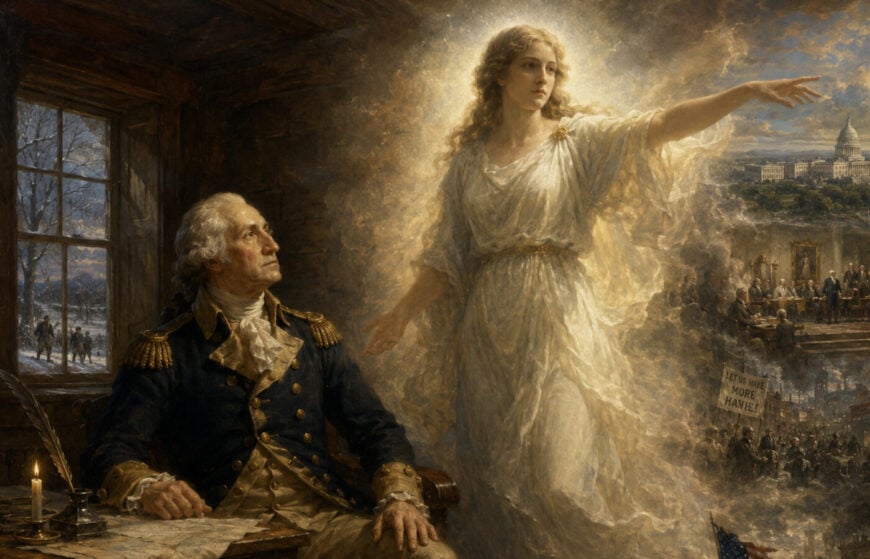
A few months later, however, Washington’s ill-equipped army endured a terrible winter at Valley Forge, Pennsylvania; unlike the British, they were short on food and warm clothing, and it was perhaps the low point of the Revolution. Washington was frequently seen kneeling in fervent prayer outside his headquarters, a stone farmhouse which still exists today. One afternoon he left strict orders not to be disturbed, but shortly afterwards realized he had an unexpected visitor in his office—whom he later called “a woman of singular beauty.” It’s not clear whether this was the Virgin Mary or an angel, but the heavenly visitor said, “Son of the Republic, look and learn.” Washington was then given three visions, the first of which showed a new nation spreading across the continent, indicating that America’s war of independence would be successful. The second vision seemed to be a harbinger of the Civil War, and the third a foretelling of perhaps World War III, each marked by great bloodshed and destruction. Then Washington heard the visitor say, “Son of the Republic, what you have seen is thus interpreted: Three great perils will come upon the Republic. The most fearful for her is the third. But the whole world united shall not prevail against her.” (A more complete account of Washington’s vision is given following this article, in a reprinted article from our very popular Volume 29 # 1/2 of Signs and Wonders for Our Times, originally printed in 2019).
The encouragement given to Washington in this manner helped him and his men persevere against all odds over the next three years until the final victory at Yorktown, Virginia, in 1781. The British had shifted their main efforts to the southern colonies, where Lord Cornwallis’ army won a number of minor victories, each followed by a timely American withdrawal. However, as he pursued the small American force under General Nathaniel Greene, Cornwallis’ supply lines lengthened. Unable to engage the Americans in a decisive battle, the British advanced to Yorktown, on the Chesapeake Bay, hoping to be resupplied by the British navy—but a French fleet prevented this. Washington’s army hurried down to Virginia, and the Americans and their French allies closed in on the British. Outnumbered and running low on supplies, the British tried to escape across the York River, but a severe rain squall made this impossible. A few days later, Lord Cornwallis was forced to surrender, in effect ending the Revolutionary War—a victory that truly turned the world upside down. As General Washington himself noted, “the perseverance of the armies of the United States, through almost every possible suffering and discouragement for the space of eight long years, was little short of a standing miracle.”
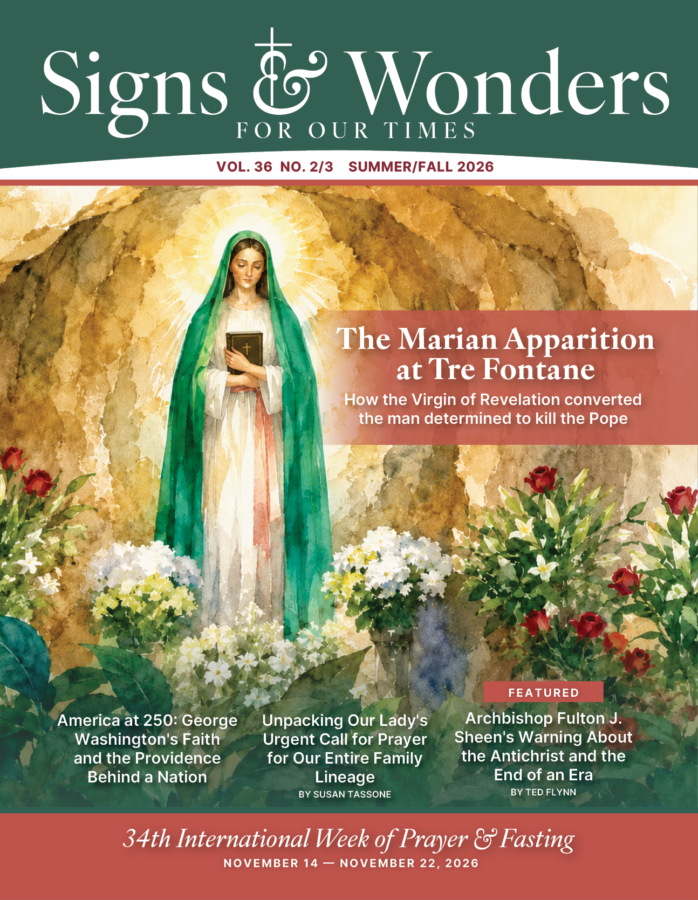
The rest of this article can be found in Signs and Wonders 36#2/3, Summer/Fall 2026. Become a member today to receive this issue!