
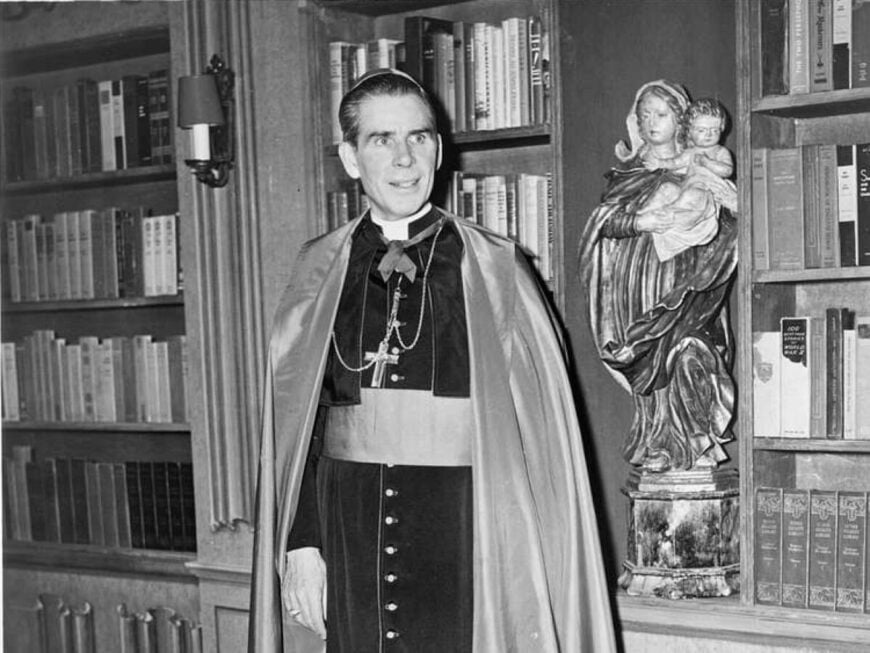
In 1979, I had a meeting with Archbishop Fulton J. Sheen that ended up shaping my life without me knowing it at the time. The event was the National Prayer Breakfast in Washington, D.C. that has been held every year on the first Thursday in February when the U.S. Congress convenes for a new session. Today, there is the Catholic Prayer Breakfast, and the National Prayer Breakfast which are two different events. This is the one that started under President Dwight D. Eisenhower in 1953 immediately after he was elected President of the United States. It was organized in conjunction with a group of laymen in Washington, DC called the Fellowship Foundation. Known informally as the “The Fellowship,” their ministry was a very wide swath from ministries around the world. Prison ministries, inner city, Christian leadership, prayer breakfasts at the state level for leaders and politicians, but generally an orientation towards discipleship to change nations, with principally a focus on national and lay leaders. Its method was to maintain confidentiality and operating in the shadows to not bring attention to the people that were being ministered to. Many of the people were just starting to grow in Christ and were well known public figures who preferred quiet at an early stage of their spiritual growth. Its footprint was very successful at the time.
It has been said, there are more influential and world leaders at that breakfast in the Hilton Hotel ball room than any other place in the entire world at one time. At capacity, the room can seat over 3,500 people with an unobstructed view of the front stage. Members from both houses of the U.S. Congress attend, business people, ambassadors, churchmen from across the spectrum of religion, and other walks of life want a ticket to attend. At least when I was there, it was a sought-after ticket. Historically, the sitting President of the United States is the key note speaker. It is billed as a non-partisan event for decades to help unify the country, but over the last number of years, that has changed due to the division in the culture, and especially politics. Not really a surprise there.
A bit of history is needed how I ended up there. In the mid 1970’s I was a student in England studying at the London School of Economics. To say I enjoyed London would be an understatement. I was always an avid reader and was reading people like Marx, Hegel, Feuerbach’s The Essence of Christianity, Ayn Rand’s Atlas Shrugged, The Fountain Head, Von Mises, Hayek, and other authors. Kind of a typical graduate student in many respects exploring different philosophies. I have always felt economics is more philosophy than math, because your view of life determines your economic views. The profound differences between Hayek and Marx show that to be true.
At the time I was dating a girl who had moved from Boston to Washington, D.C. after graduating from Boston College. After a few months in London, a copy of Mere Christianity by C.S. Lewis arrived in the mail from a girl by the name of Maureen, the Boston transplant now living in DC. I remember picking it up, and was first struck how small the book was from something so well-known and impactful. I knew little of Lewis at the time as that thinking had never really been a part of my life. I had heard of the Screwtape Letters, and the Chronicles of Narnia, but never had any interest in the myth of Narnia which I knew was Lewis, as history and philosophy had been my intellectual interest. When I sat down to read Mere Christianity I had the same experience Edith Stein had when devouring The Autobiography of Saint Teresa of Avila after staying up all night reading it. As Stein, I stayed up for a single all night read, and I knew when I finished, I had witnessed truth. I said to myself, if I didn’t follow this philosophy of life as a new pattern and ideology and what was written in that book, I was a total phony. All others endeavors were man’s intellectual folly, musings, pride, and fluff. That was the first shot across the jaw that knocked my stiff-neck sideways.
The second book I read several months later that was the body blow and gut punch that bent me over — for good. It was a book I picked up in a London bookstore called Peace of Soul by Fulton Sheen. I knew a modest amount of Sheen, so I gave it a try. It had the same effect on me as Lewis, but its orientation was the relationship between the psyche (mind or spirit) and the soma (the body) for a proper conduct of living in the world. Sheen argued Christianity brought a structure to living I had never read before. The mind and body were both important to be productive and healthy in life, and was the only solution to a life worth living as given by our Creator for the benefit of man. The book had been Sheen’s Ph.D thesis when he was at the University of Louvain (Leuven in Belgian Flemish) in Belgium, where Sheen won the highest honor called the Cardinal Mercer Award. That thesis later became the book Peace of Soul. After reading both books I never looked back that any other way than Jesus Christ was a satisfactory way of life. I have never questioned my decision even once. I knew what I had seen in the world, and Christ was the only answer as Sheen and Lewis had made clear. As time went on, I read more of Sheen and how his Holy Hour was the absolute necessity he did every day to get his daily bearings to hear God in the silence of prayer, thought, and spiritual reading. It was his secret sauce where his power and authority came from, and he made that abundantly clear. It is in that practice he married his suffering to Jesus on the cross and received light from the Holy Spirit. His victimhood as a priest was made there to serve man where he emptied himself out in the form of a slave as Christ had done. Although I must admit a Holy Hour has never been a life-long practice for me, my quiet times have been based on Sheen’s model. As a result, I have always felt it is the one thing that is most important to live a life directed by Christ. Sheen’s thought on that became more concrete for me to see how important it is to live a rich spiritual life – abundant living (John 10:10b).
I never grew up with Sheen’s TV show as I remember more of Jackie Gleason, Danny Thomas, and Disney, as we watched very little TV in my home. I never remember watching his TV show Life is Worth Living until much later, but have since read many of Sheen’s works, including his autobiography called Treasure in Clay which came out shortly after his death, a book on the Blessed Mother called, The World’s First Love: Mary Mother of God, and a book called, The Wit and Wisdom of Fulton Sheen, and others. Sheen had a devout Marian outlook and was vocal in Our Lady’s role in the world which I always admired. It was centered, and doctrinal with Magisterium teaching. He made annual pilgrimages to Lourdes for decades. My favorite of all Sheen works is the series of talks he gave in Ireland to nuns that I listened to for years while commuting to work. I had whole sections of those talks memorized as I listened to them frequently. Sheen became a model for me as he was very active in the world with his faith where it was something I could relate to as a married layman.
After moving back to Washington, I moved to Northwest D.C. not far from the White House, and lived around the corner from where the Fellowship Foundation had a very large home that was used for meetings from people all over the world. It was a home of constant activity. I met a lot of people from diverse backgrounds and it became my life in every way: Bible studies, social events, talks on Tolkien, seminars by heads of state, politics, academics, discipleship meetings, and so forth. Activities on everything imaginable.
After I met many of the D.C. people around the National Prayer Breakfast movement, I was asked if I wanted to be a Fellow of the Foundation. They chose two young men every year with an agenda to expose them to the larger body of Christ with their many ministries. The terms were it lasted 365 days and then you would have to go back and find work, and bring what you learned to those around you to change the world— one person at a time. They asked me my needs that I needed to pay rent and live, and I told them. I had just been married and didn’t really need much so that was quick. They met my financial needs and for the entire next year, all I did was meet people from every walk of life. One Christmas Eve I was in a maximum-security prison in Lorton, Virginia with people on death row for a Bible study. I was in the wedding of the former head of the Klu Klux Klan (that KKK), of Mississippi no less, and over time the man became an Episcopal priest after two U.S. Senators and Chuck Colson of Prison Fellowship helped get him out of prison after a Saint Paul experience. We renovated homes in the inner city and were invited to watch Billy Graham help arbitrate a steel workers dispute before a planned strike. The only structure for me was managing logistics for young leaders around the world coming to the National Prayer Breakfast, a several-day event.
As much as the breakfast was where the sitting president of the United States traditionally spoke, there was always a leading clergyman who had a speaking role since its beginning in 1953. It had always been an evangelical leader until 1979. I asked if the breakfast had ever had a Catholic and they said no. I said why not invite Archbishop Fulton Sheen because he was so well known and was very elderly in 1979? Sheen was then asked and he came to speak. I made sure I had a seat right up front and 15 feet away was President Jimmy Carter, Archbishop Sheen, Billy Graham, and other dignitaries sitting next to each other at the head table. A member of Congress was always the Emcee. Sheen’s thoracic surgeon sat next to him because just prior he had heart surgery. He never touched his breakfast other than a drink of water.
After the breakfast I asked Bishop Sheen if I could speak to him. He invited me to his room as he was wheeled up in a wheel chair by his surgeon, and we spoke for about an hour as he asked me my background. We first spoke of pleasantries of him being the first Catholic to ever address the National Prayer Breakfast since 1953, and he said he enjoyed it. Then I asked him the single question I wanted to ask. Although much is forgotten of the general conversation, I told him I wanted to be God’s man and what that would take? I quoted the verse from 2 Chronicles 16:9, that said “The eyes of the Lord roam to and fro all over the world looking for the man’s heart that is perfect towards Him.” I said to Sheen I wanted to be that man. What came out of his mouth next actually surprised me, because I thought he would have said other things. But what he said was, “Never join an organization.” He then explained that when you join an organization to rise in leadership after investing time and resources, there will be rules to follow that will prevent you from speaking the truth as God may ask of you. He said, over time if you are too bold with the truth you will no longer be welcome in that group as you will go beyond what they can hear, and you will be marginalized for your views after such an effort. Wow, that was unexpected where I thought he would speak of Holy Hours, prayer, Scripture study and other things.
Upon leaving the most unexpected thing happened. As Sheen’s surgeon was wheeling him out of the room, there was a maid’s utility cart in the middle of the corridor preventing his wheel chair from passing. Sheen looked directly at the woman and asked her name, and where she was from (she was Jamaican), and politely and gently speaking to her soul asked her if she could please move the cart so he could pass. At 26 years old, 190 pounds I burst into tears. I had previously hitch hiked for six months in Europe and the Near East on my own leaving school in Switzerland years prior with $400.00 dollars in my pocket. I slept on beaches, park benches, lived in a tree hut in Israel at the Gulf of Aqaba for two weeks picking cucumbers in the desert at 5:00am to make some money, and other activities in over 20 countries as an adult, and I burst into tears with an Archbishop Sheen comment to a hotel cleaning lady. I had never seen anyone speak so gently to a person’s soul as if they were the only person in the world before. It was not what he said, but how he said it to a poor maid in a hotel corridor. To him she was another Christ to treat respectively and kindly. When Sheen looked and spoke to you, he spoke to your soul – your inner most desires as I have described it, and I had never seen that before from anyone. His eyes were like piercing glass agates. That was the fruit of his daily prayer that comes from redemptive suffering and a life centered “in Christ.” Something he knew a lot about as he had enemies in the Church as all great saints did. Well, I recovered, realizing I must have looked like a blithering idiot.
Over the course of his time in the priesthood, Sheen suffered in many unknown ways. There were petty jealousies among priest and bishops, battles with some in the United States hierarchy with one skirmish with Cardinal Spellman of New York ending up in the study of Pope Paul VI. Over a radio or TV broadcast one day in the late 1950’s, Sheen as President for the Propagation of the Faith, asked every kid in America to send him a dime to help the missions. They responded by the tens of thousands (and many more well to do), and the program got so big, the United States Mint asked Sheen not to do it again as he was taking dimes out of circulation! The money came in so substantial for the missions Cardinal Spellman said he wanted some of that for his use as Archbishop of New York. Sheen said it was for the missions. The dispute over distribution of funds went to Rome. After the presentation of opinions, Pope Paul Vi sided with Sheen, and from then on Cardinal Spellman made life difficult for Archbishop Sheen. Yes, he had his own crosses to bear that he was able to resolve in his own victimhood as a priest in his Holy Hours.
As Jesus said, “They hated me before they hated you” has given me comfort in my own battles over the years. For over thirty-five years I have written on subjects some in the Church find difficult to address. Subjects like globalization, Magisterial teaching being ignored by some clergy, abortion, homosexuality, Freemasonry and Secret Societies, apparition sites like Medjugorje and Garabandal, and other sensitive subjects not often addressed from the Sunday pulpits due to being too controversial. Thus, some clergy often ignore their reality, yet many faithful laity embrace the truth of the issues and are frustrated by the silence inside the Church. Sheen feared nothing and said it clearly to the general population in the language they could understand. I was always able to find inspiration in that from the talks I heard from Sheen later in life. With truth comes enemies and controversy—The Way of the Cross.
Several weeks after our visit in the hotel room, a copy of Peace of Soul arrived to my residence with a signed inscription from Sheen. Archbishop Sheen died nine months later on December 9, 1979, at the age of 84. Through a single meeting, my life path went in a direction that has proven to be good for me, as I look back and see how things have worked out. During that time had I joined an organization, I am certain those organizations would not have approved of many of my writings and talks on subjects many Catholics consider too challenging. But, not for Archbishop Fulton J. Sheen. Archbishop Fulton Sheen pray for us.
Oh, by the way, I married the girl who sent me Mere Christianity.