
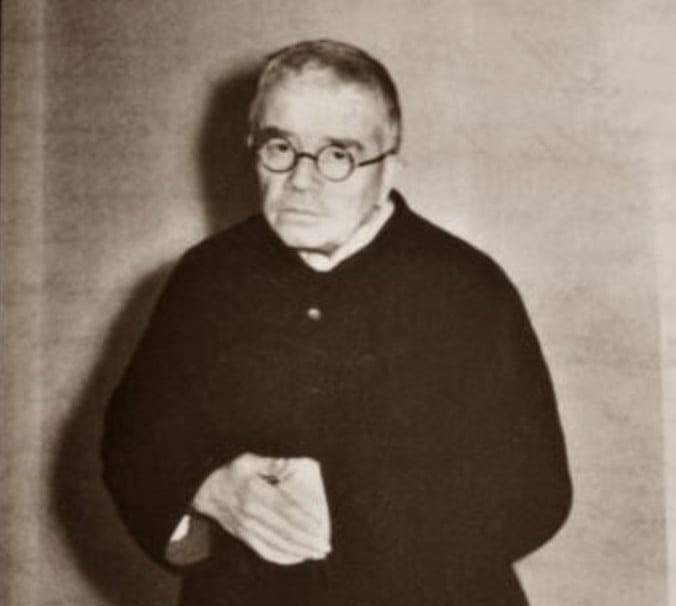
In 1913, Don Dolindo went one day to Pellegrini Hospital in Naples to pray with the patients there.
“Upon entering the surgery ward for men,” he writes in his autobiography, “I seemed to see Jesus Himself stretched out on those beds of suffering.”
One of those patients was a young shoemaker named Luigi Capriglioni, whose foot had been crushed under the wheel of a streetcar. The doctors in the hospital had amputated part of his foot.
Luigi was greatly distressed and could not bear the thought of being lame. He told Don Dolindo he was going to take his own life.
Dolindo comforted the young shoemaker, and then said, “I want you to remember what I am about to say to you: One day soon you will give thanks to God for this accident with your foot and for becoming lame.”
Two years later, World War I broke out in Italy, and Luigi came to see Don Dolindo.
“You were right,” he told Dolindo. “I am really thankful to God for being lame, for if I wasn’t lame, I would have been sent to war.”
Don Dolindo had seen Jesus Himself stretched out on the hospital bed when he first looked at Luigi because Christ was suffering His Passion in him. In the Mystical Body, each person’s suffering is Christ’s suffering. The streetcar and the scalpel that pierced Luigi’s foot were the nails that pierced Jesus’ feet. The injury that rendered Luigi’s leg lame was the wound that bound Jesus’ legs to the Cross.
It might seem ironic that Luigi was a shoemaker by trade. That this man who helped people walk was prevented from walking. This man who cared for the feet of those who came to him had his own foot severed. And yet the irony points to a greater truth: the divine paradox of the Cross.
For Jesus, too, was a man who helped others walk and who cared for the feet of those who came to Him. He who healed the lame was prevented from walking when he was nailed to the Cross. He who washed his disciples’ feet on the night before he died had no one to wash His dirty and bloody feet as He hung on the Cross.
Luigi’s suffering had so much in common with Christ’s because it was Christ’s. And because it was Christ’s, the very affliction that Luigi saw as a reason for death had already been transformed into a life-saving grace by Christ who suffered in him.
Dolindo recognized this grace because he recognized Christ in Luigi. And following his example, we who are Dolindo’s spiritual children can all recognize the same grace in our own lives and in the lives of those around us.
What affliction do we carry today that feels unbearable? It is Christ’s affliction, too. That means Dolindo’s words for Luigi are for us as well: One day soon we will give thanks to God for this affliction.
For it is not only a prophecy that Dolindo gave to one shoemaker back in 1913. He wrote it in his autobiography because it is also for us. Not just for us to read about but for us to live.
It is the same promise that Saint Paul offers in Romans 8:28: “We know that in everything God works for good with those who love him, who are called according to his purpose.”
God works for good in everything. In Luigi’s streetcar accident and in his amputation. In Dolindo’s lifelong suffering and in his unjust condemnation. In whatever we are enduring today and whatever we are suffering in this very moment.
Like Luigi’s amputation, our afflictions may make us feel lame, worthless, and unable to do the good we did before. But with Dolindo’s help, we can remember that those are all signs that it is Christ Himself who is suffering in us. And in Him, these wounds will heal the world.
With gratitude to Maria Palma Smith for the use of her English translation of the book Amore, Dolindo, Dolore (Casa Mariana Editrice “Apostolato Stampa”, 2001). Publication of the English translation is forthcoming from Academy of the Immaculate Publishing.
P.S. I just received the wonderful news that the book Jesus, I Surrender Myself to You: The Life of Don Dolindo Ruotolo by Grazia Ruotolo (Dolindo’s niece) and Luciano Regolo, and translated by my friend Maria Palma Smith, is now available for order! Thanks be to God that this translation is now available in English!

Maura Roan McKeegan is the author of twelve Catholic picture books, including the award-winning Old and New series (Emmaus Road Publishing); Julia Greeley, Secret Angel to the Poor (Ignatius Press); and Seven Clues: A Catholic Treasure Hunt (Loyola Press), co-authored with Scott Hahn. She is also a contributor to various magazines. This article originally appeared on the author’s Substack, Stories of Don Dolindo, and is republished here with permission.